

Microsoft Built the Exposure. Your Agency Owns the Risk
A threat actor with a documented track record has named the date. Thousands of federal systems will be permanently unpatched by then. You have six weeks.
08 JUL 2026 UPDATE
Nightmare Eclipse announced the following update on their blog. The promised attack against a major Microsoft platform has been post-phoned, although they will still drop something for July’s Patch Tuesday next week.
-----BEGIN PGP SIGNED MESSAGE-----
Hash: SHA512
I won’t drop what I talked about last blog, that seems to need more research and investigation...
Regardless got smtg for this month, it will be the least interesting and least impactful bug I dropped since I started but Microsoft legit just stopped pocking me and pissing me off so I’m conserving some energy for next month, because I know they will definitely piss me off by then.
-----BEGIN PGP SIGNATURE-----
iHUEARYKAB0WIQRJTvAf/AWVhAKEeb7FFoRCS0/SbAUCakguLwAKCRDFFoRCS0/S
bD0yAQDrkmvenG5NJ+bnt6FHdcPPaCAyuN2ZuAVcdUuQkHKhuAEA9kr3pxpeHx3n
R5i6YU5sDhSvNPSIVf9rkD9CQY9uOAw=
=yOrR
-----END PGP SIGNATURE-----
In late 1998, the people who understood the Y2K problem well enough to be frightened by it faced a peculiar communications challenge. The risk was real, technically well-understood, and date-certain. The vulnerable population was enormous. The mitigation window was finite and shrinking. And yet the default organizational response, in government, in the private sector, and in the military, was to assume someone else was handling it.
We are in that moment again. The date is July 14, 2026.
What Is Converging on July 14
Three things are happening simultaneously on that date, and the overlap is not coincidental.
First: July 14 is Microsoft’s monthly Patch Tuesday, the most watched day in the enterprise security calendar, when Microsoft releases security updates for its products and the entire defender community pivots to assess, test, and deploy patches across millions of systems worldwide.
Second: July 14 is the date Microsoft permanently ends extended support for SharePoint Server 2016 and SharePoint Server 2019.[1] After that date, both platforms will continue to run. Nothing shuts off automatically, but Microsoft will issue no further security patches, bug fixes, or technical support for either version. Any vulnerability discovered in SharePoint 2016 or 2019 after July 14 is, by definition, permanently unpatched on those platforms.
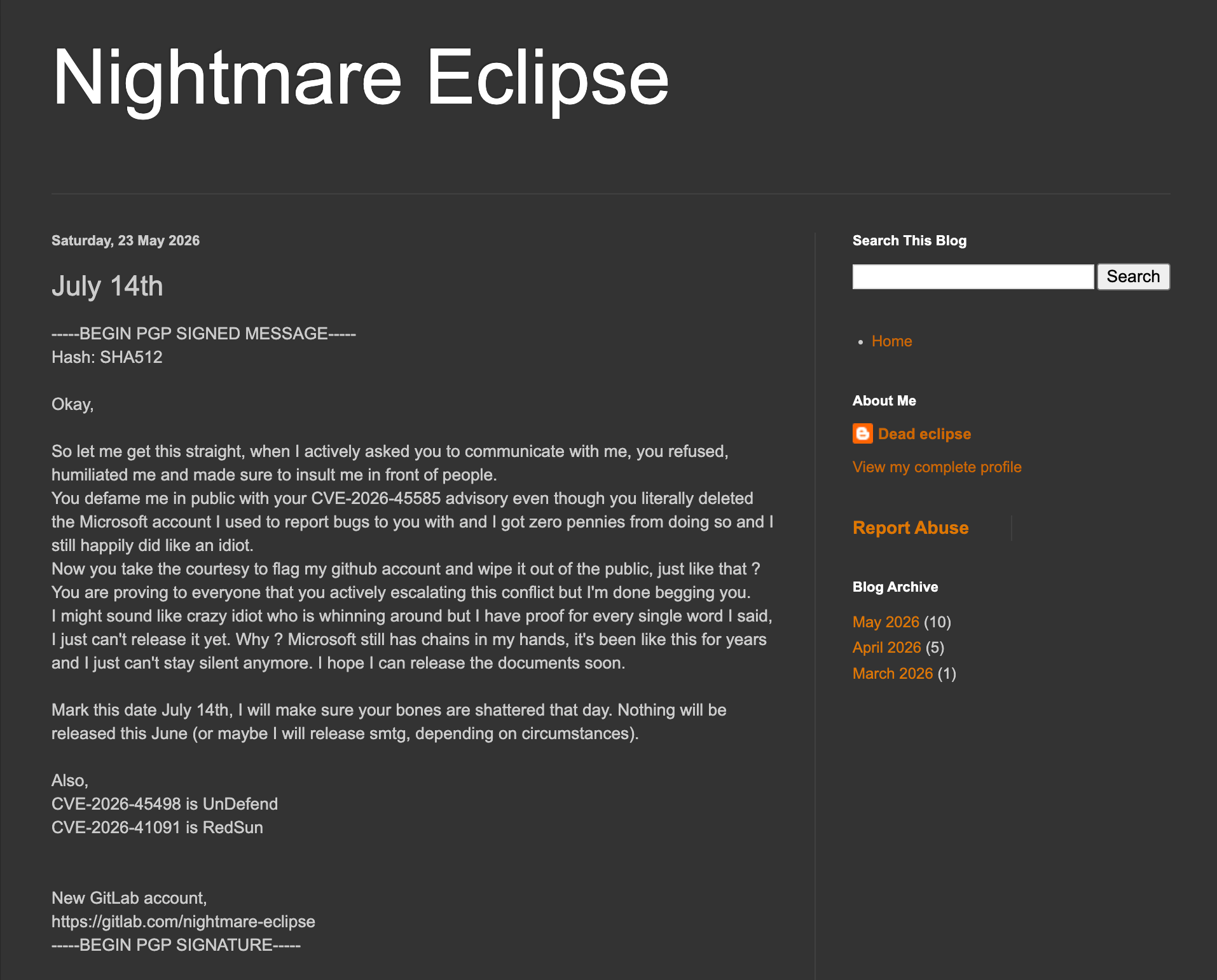
Third: a pseudonymous security researcher known as Nightmare Eclipse, who has already released six weaponized zero-day exploits targeting core Windows components since early April, three of which were confirmed under active exploitation within days of release, has publicly threatened a major disclosure on July 14.[2] In a post directed at Microsoft, the researcher wrote: “Mark this date July 14th. I will make sure your bones are shattered that day.”[3]
Whether the July 14th threat materializes, targets SharePoint specifically, or proves as severe as feared is unknown, what is known is the exposure. Your organization is either hardened for this window or it isn’t.
Who Is Actually Exposed
The vulnerable population is specific and, in national security terms, alarming.
During the July 2025 ToolShell exploitation wave, researchers at Censys identified 9,717 on-premises SharePoint servers that were directly internet-exposed.[4] Those are only the visible ones. Air-gapped and internally accessible deployments are not counted in that figure. The actual population of organizations still running SharePoint 2016 or 2019 is considerably larger, concentrated in the sectors least equipped to absorb a mass exploitation event: federal government, defense, intelligence, healthcare, and finance.
Government agencies are disproportionately represented in this population for a structural reason. Migrating to cloud-based SharePoint requires obtaining a new Authority to Operate under FedRAMP, a process that can take months to years. Many agencies are caught between a legacy platform they can no longer safely run and a cloud migration they haven’t completed. Some DoD and intelligence community environments run air-gapped networks that cannot migrate to cloud by definition. For those organizations, “migrate before July 14” is not an available option. Hardening is.
The federal government’s exposure to SharePoint vulnerabilities is not hypothetical. In July 2025, ToolShell, a chained exploit combining remote code execution and authentication bypass, was used against over 400 organizations worldwide, including multiple federal agencies and state and local governments.[5] The Department of Energy confirmed that both DOE components and the National Nuclear Security Administration were affected, though the agency characterized the impact as minimal and said a very small number of systems were involved.[6] The vulnerability was patched, but the structural conditions that made federal agencies vulnerable to ToolShell in 2025 have not changed.
Why July 14 Is Different From a Normal Patch Tuesday
The feature that makes Nightmare Eclipse genuinely dangerous, and different from the established norms of security research, is not the disclosure of vulnerabilities. It is the simultaneous release of weaponized, working proof-of-concept exploit code.
Standard practice, even among aggressive disclosers who publish over vendor objections, maintains a professional line between disclosure and arming. Publishing a technical description of a flaw allows skilled researchers to reproduce it. Publishing working exploit code hands a loaded weapon to anyone who can download a file.
The practical consequence is a collapse in what security professionals call the weaponization-to-exploitation window. Under normal conditions, even after a vulnerability becomes public, threat actors require days to weeks to reverse-engineer the flaw, develop working exploit code, test it, and deploy it against targets. That window is what gives defenders time to patch. When working exploit code is released simultaneously with the disclosure, that window closes. The barrier between “I know this vulnerability exists” and “I have working code to exploit it” drops to zero.
Huntress Labs confirmed active exploitation of Nightmare Eclipse’s BlueHammer, RedSun, and UnDefend exploits within days of their release in April.[7] The gap between code on GitHub and attackers using it against real enterprise targets was not weeks. It was hours.
Enterprise patch cycles do not operate in hours. Even well-resourced organizations with mature patch management programs operate on weekly or bi-weekly cycles, with additional time required for testing before updates reach production systems. When the exploitation window collapses to hours, patching after the fact is not a defense strategy. It is a damage assessment strategy.
On July 14, if Nightmare Eclipse releases weaponized exploit code against SharePoint 2016 or 2019 on the day those platforms permanently lose patch support, the organizations most likely to still be running those platforms are also the ones with the slowest patch cycles, the most complex IT environments, and the most sensitive data.
What to Do Right Now
While six weeks is a short window, it is not an empty one.
The Y2K parallel holds: the relatively benign outcome of that crisis was not evidence that the warnings were overblown. It was the result of organizations taking date-certain, technically understood risks seriously early enough to act. The actions below reduce exposure regardless of what Nightmare Eclipse does on July 14.
Inventory immediately. Every organization running on-premises SharePoint should know today exactly which version it is running, how many instances exist, and which are internet-facing. This is not a complex technical task. It is a governance task that should have been completed months ago.
Take internet-exposed SharePoint 2016/2019 offline or behind a VPN now. If your organization has SharePoint servers directly accessible from the public internet that are not going to be migrated before July 14, reduce that attack surface today. Censys could see your server during the ToolShell wave. So can every threat actor who knows how to run a scan.
Accelerate or emergency-authorize migrations. For organizations mid-migration, July 14 is a forcing function that justifies emergency procurement authority, expedited FedRAMP review requests, and executive-level prioritization. The cost of an accelerated migration is known and bounded. The cost of a mass exploitation event is neither.
Segment aggressively. For environments that cannot migrate before July 14, including air-gapped defense and intelligence installations, network segmentation, enhanced monitoring, and restricted lateral movement capabilities reduce the blast radius of a successful exploitation. This is not a substitute for patching. It is a risk reduction measure for the window in which patching is not available.
Brief leadership before the end of June. This is a board-level and agency-head-level risk event, not a patch management task. The officials responsible for mission continuity need to understand what July 14 represents before it arrives, not after.
Ensure CISA KEV alerts are operationally connected. The CISA Known Exploited Vulnerabilities catalog exists precisely for situations like this. Verify now that alerts are flowing to operational security teams with defined response timelines — not being logged and reviewed quarterly.
The Deeper Problem July 14 Exposes
None of this would be a crisis if Microsoft’s security culture matched the scale of its infrastructure footprint.
The federal government’s dependence on Microsoft products is total in ways that have no equivalent in the private sector. Exchange Online handles diplomatic communications. SharePoint manages classified workflows. Azure hosts systems whose compromise has resulted in Chinese intelligence services reading the email of America’s most senior diplomats. The Cyber Safety Review Board, after investigating the 2023 Exchange Online breach that exposed the accounts of the Commerce Secretary, the U.S. Ambassador to China, and senior State Department officials, concluded that the intrusion was preventable, that it reflected a cascade of security failures at Microsoft, and that Microsoft’s security culture was inadequate and required an overhaul.[8]
The researcher at the center of the July 14 threat claims to have exhausted conventional reporting channels, only to have had their Microsoft Security Response Center account deleted, their vulnerability reports ignored, and their bug bounty payments withheld.[9] Whether or not every element of that account is accurate, it describes a failure mode in Microsoft’s researcher engagement that the security community has documented repeatedly. When the world’s largest software infrastructure company treats its most capable outside eyes as adversaries rather than assets, it removes the early warning layer that might catch what internal teams miss. July 14 is the result.
A Final Note on Proportionality
The Y2K crisis ended well. Not because the risk was overstated, but because enough organizations took the warning seriously early enough to act. The people who called it a false alarm after the fact were confusing outcome with probability.
July 14 may also end quietly. Nightmare Eclipse may not follow through. The disclosure may affect platforms other than SharePoint. The payload may be less severe than feared. None of that changes the calculus for a federal agency, a hospital network, or a defense contractor still running SharePoint 2016 today. We have a credible threat against a known target set, on a specific date. The clock is ticking.
Notes
[1] Microsoft. “SharePoint Server 2016 and 2019 End of Support.” Microsoft Lifecycle Policy. Confirmed end-of-extended-support date: July 14, 2026. https://learn.microsoft.com/en-us/lifecycle/products/sharepoint-server-2019
[2] Barracuda Networks. “Nightmare-Eclipse: Six Zero-Days, Six Weeks and One Big Grudge.” Barracuda Blog, May 19, 2026. https://blog.barracuda.com/2026/05/19/nightmare-eclipse-zero-days-grudge
[3] Cybernews. “Microsoft’s Nightmare: GitLab Removes Rogue Security Researcher Days After GitHub Ban.” May 27, 2026. https://cybernews.com/security/gitlab-bans-rogue-researcher-releasing-windows-zero-days/ Note: Nightmare Eclipse’s gender is unknown. Coverage by The Register, Barracuda, and others uses they/them. This article follows that convention.
[4] Cybersecurity Dive. “What We Know About the Microsoft SharePoint Attacks.” July 24, 2025. Censys figure of 9,717 internet-exposed on-premises SharePoint servers cited as of the ToolShell exploitation wave. https://www.cybersecuritydive.com/news/what-we-know-microsoft-sharepoint-attacks/753961/
[5] CyberScoop. “Microsoft SharePoint Attacks Ensnare 400 Victims, Including Federal Agencies.” July 24, 2025. https://cyberscoop.com/microsoft-sharepoint-attacks-400-victims-us-agencies/
[6] BleepingComputer. “US Nuclear Weapons Agency Hacked in Microsoft SharePoint Attacks.” July 24, 2025. DOE spokesperson statement: “The Department was minimally impacted due to its widespread use of the Microsoft M365 cloud and very capable cybersecurity systems. A very small number of systems were impacted.” https://www.bleepingcomputer.com/news/security/us-nuclear-weapons-agency-hacked-in-microsoft-sharepoint-attacks/
[7] Notebookcheck. “Microsoft Faces Security Community Backlash Over Nightmare Eclipse.” May 29, 2026. BlueHammer (CVE-2026-33825), RedSun (CVE-2026-41091), UnDefend (CVE-2026-45498) confirmed exploited in the wild. https://www.notebookcheck.net/Microsoft-faces-security-community-backlash-over-Nightmare-Eclipse.1311160.0.html
[8] U.S. Department of Homeland Security, Cyber Safety Review Board. “Review of the Summer 2023 Microsoft Exchange Online Intrusion.” April 2, 2024. https://www.cisa.gov/sites/default/files/2025-03/CSRBReviewOfTheSummer2023MEOIntrusion508.pdf
[9] The Register. “Microsoft 0-Day Feud Escalates as Researcher Threatens Another Windows Exploit Dump.” May 28, 2026. https://www.theregister.com/security/2026/05/28/microsoft-0-day-feud-escalates-as-researcher-threatens-another-windows-exploit-dump/