

China, Iran, and Two Satellite Stories
One claim collapses under scrutiny. The other holds up. The difference between them is a lesson in how to read a leak.
Preface: Two claims, two very different answers
In the space of a few months, two striking claims circulated about how China has been helping Iran target American forces in the Middle East. Both sound alarming. Both involve Chinese space technology. Both arrived wrapped in confident technical detail. And yet one of them largely falls apart when you trace it to its sources, while the other stands up remarkably well.
This two-part piece works through both, using the same method for each: take the claim apart, follow every specific back to where it actually originates, and separate what is documented from what is inferred from what has simply been repeated until it sounded true.
Part One examines the theory that China gave Iran access to B3A, the encrypted military signal of its BeiDou satellite-navigation system — a supposedly “unjammable” capability that let Iranian missiles strike with new precision. This one is a media artifact. It was built by inference on top of a mundane civilian statement, given fake-precise technical specs by an uncited blog, and then debunked by the actual experts on satellite-navigation security.
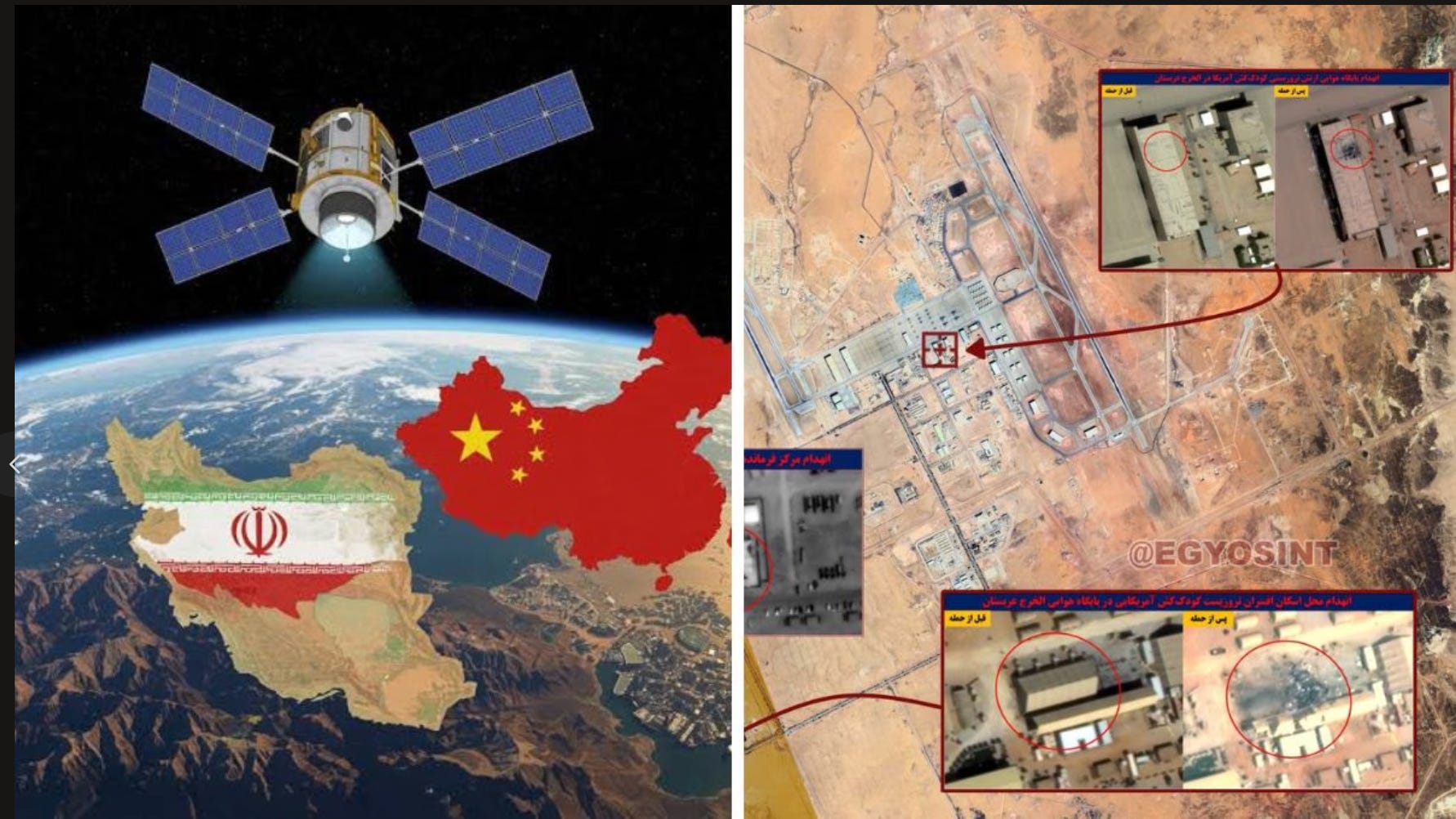
Part Two examines the Financial Times‘s April 2026 investigation reporting that Iran secretly bought a Chinese spy satellite — TEE-01B — and used it to image US bases before and after strikes. This one is real. The satellite is in the public catalog, the companies were documented years earlier, the FT verified the leak against independent orbital data, and the US government sanctioned the builder weeks later.
The first story is what it looks like when many outlets trace back to a single unsourced root. It reminds me the Iraq WMD intelligence failure. The second is what it looks like when independent evidence corroborates the initial report.
Part One — Did China Hand Iran a Jam-Proof Targeting System?
Tracing the BeiDou “B3A” rumor to its sources.
The short version
A theory has circulated since early 2026 that China supplied Iran with B3A — the encrypted, restricted military signal of its BeiDou satellite-navigation system — and that Iran used it to guide missiles with new precision, defeating GPS jamming because BeiDou is “unjammable.” After tracing the claim to its primary sources:
The rumor is a media construction, not an intelligence finding. It was built on top of a real but civilian Iranian statement, given technical specifics by an uncited defense blog, attached to a single named analyst, mainstreamed by Al Jazeera as an open question, and then debunked by the leading academic experts on navigation-signal security.
There is no primary source establishing that Iran has B3A military access. The strongest-sounding anchor dead-ends in a single vague Iranian state-media headline, upgraded through repetition and pinned to a 25-year agreement whose text is secret.
“BeiDou is unjammable” is false. Because all satellite-navigation systems share overlapping radio frequencies, a broadband jammer degrades BeiDou, GPS, and Galileo at once. The physics is the same for all of them.
Iran’s missiles did not become more accurate by dropping GPS. More Iranian missiles struck Israel because Iran fired far more of them and interceptor stocks ran low — a defense-saturation story, not a guidance story. And the underlying logic is backwards: under jamming, a better navigation source could at most restore baseline accuracy, never exceed it.
Combining Fact w/ Rumor
Almost every article on this subject blurs two very different claims:
Claim A (documented, civilian). In roughly July 2025, Iran’s Deputy ICT Minister Ehsan Chit Saz said Iran was moving toward BeiDou for navigation “because its control lies entirely in China’s hands.” This is a statement about sovereignty and general/civilian BeiDou. It says nothing about military signals, missiles, or the war.
Claim B (the rumor). That Iran obtained the B3A encrypted military service — the restricted tier used by China’s own military and, uniquely among foreign militaries, Pakistan’s, and used it to guide weapons.
Here’s the rub. BeiDou’s open civilian signal is free to the entire planet, and access / use requires nothing from China. Only Claim B would represent China actively arming Iran’s targeting, and Claim B is the one with no primary source behind it. Every dramatic element of the theory lives in Claim B, built by inference on top of Claim A.
Where the rumor came from
The propagation trail shows a media artifact rather than a leak:
The seed (~July 2025). Chit Saz’s real but civilian statement, reported by Iranian state agency ISNA and by Al Jazeera.
Hype layer (Aug 2025). A Chinese-nationalist outlet and a Chinese GNSS-hardware vendor (in marketing copy) added claims of “one-meter” missile accuracy. Still no mention of B3A.
The invention (Feb–Mar 2026). Defence Security Asia published the now-viral technical package — “B3A military signal,” “98% positioning reliability under electronic warfare,” “frequency-hopping,” “GPS failure exceeding 70%” — citing zero sources. This is the template everyone else copied.
The named human origin (Mar 10, 2026). Military analyst Patricia Marins, quoted in bne IntelliNews, called B3A “essentially unjammable.” That single assertion is the most-cited human source for the military-signal claim.
Mainstreaming (Mar 11, 2026). Al Jazeera gave the story global reach — but framed it honestly as an open question (”Iran has not confirmed this”), resting it on inference: targeting appeared to improve, therefore B3A.
The debunk (Mar 13, 2026). The one set of genuine technical experts to examine the claim — UT Austin’s Todd Humphreys, the leading academic authority on navigation-signal spoofing, and the Resilient Navigation and Timing Foundation — rejected it. Humphreys: BeiDou has “no magical remedy,” is subject to “the same physics” as GPS, and “it would be more surprising if [Iran] got access to the military codes.”
Fringe recycling (mid-2026). ZeroHedge, Unz Review, and assorted Substacks keep the claim alive — one iteration of which is explicitly labeled speculative fiction.
The chain, distilled: a real civilian statement → partisan and vendor hype → an uncited blog inventing the military specifics → one analyst putting a name to it → Al Jazeera mainstreaming it as a question → the actual experts debunking it → fringe blogs recycling it.
What B3A actually is, and how little is publicly known
The most important technical finding is how thin the public record is. B3A is real, encrypted, and restricted, but as a public object it is close to a black box.
What the record actually shows:
Frequency: Sits in BeiDou’s B3 band, centered at 1268.52 MHz. Documented.
Public specification: none. China has published an interface control document for its open signals only. There is no public spec for B3A. Everything below is inference.
Modulation: believed to be BOC(15, 2.5), inferred by Western researchers (notably Germany’s DLR) measuring the satellites’ spectrum — not from any Chinese document.
“Frequency-hopping”: weakly sourced and probably a misnomer. Its home is an uncited blog. What is genuinely likely, by analogy to every military navigation system, is an encrypted, unpredictable spreading code, which writers loosely call “frequency-hopping.”
Access: China’s military, plus Pakistan’s armed forces since 2018 - the one well-documented foreign case. Iran’s alleged access rests on far weaker sourcing.“
~10 cm precision” / “98% reliability” Promotional figures with no primary measurement behind them.
B3A versus GPS M-code
Structurally the two are cousins, not clones: both are wideband encrypted military signals on a dedicated channel, delivered to keyed receivers, with analogous anti-jam intent. But the contrast that matters is documentation and one capability gap.
B3A vs. GPS M-code
Public documentation — M-code: extensive (modulation, receiver program, and rollout all in government and peer-reviewed sources). B3A: classified; no public spec, details inferred or asserted.
Anti-jam power boost — M-code: documented steerable spot beam, ~20 dB (≈100×) local power boost on GPS III/IIIF. B3A: no comparable documented spot-beam capability — a genuine gap in the public record.
Receiver ecosystem — M-code: MGUE program, ~1 million cards, public oversight. B3A: China and Pakistan only; essentially no public detail.
Public verifiability — M-code: high. B3A: low.
GPS M-code is the more capable and vastly better-documented system. The popular framing inverts this ; meaning it treats B3A as superior precisely because nothing about it can be checked.
Can it be jammed? Yes. The “unjammable” premise is false
The theory’s load-bearing technical claim is that Israel’s jamming failed against BeiDou because BeiDou can’t be jammed. This is wrong, and the reason is simple physics:
All satellite-navigation systems — GPS, BeiDou, Galileo, GLONASS — occupy overlapping L-band radio frequencies by international coordination. BeiDou’s modern civilian signal sits on exactly the same frequency (1575.42 MHz) as GPS’s civilian signal.
A broadband jammer therefore floods the whole band at once. It does not need to “know” it is jamming BeiDou; raising the noise floor denies every system on those frequencies. Multi-constellation jammers are standard, off-the-shelf equipment.
The genuinely hard target is the encrypted military signal — for BeiDou’s B3A exactly as for GPS’s M-code. But even an encrypted signal can be jammed by brute-force noise; encryption chiefly defeats spoofing, because you cannot forge a code you cannot predict.
Humphreys and the Resilient Navigation and Timing Foundation made exactly this point. The only scenario in which BeiDou would give Iran a real edge is if Iran held keyed B3A military receivers — the unproven claim, not an established fact. Civilian BeiDou is as jammable and spoofable as civilian GPS.
Did Iran’s missiles get more accurate by abandoning GPS? No.
This claim conflates two separate things: “more missiles got through” (true) and “missiles got more accurate” (not supported). The outcome was a defense-saturation and interceptor-depletion story:
Iran fired ~500–570 ballistic missiles, versus ~120 in April 2024 and ~180–200 in October 2024 — roughly 2.5–4× the volume, over twelve days.
The Israeli military itself said the interception rate (~86–90%) was “similar to” the 2024 attacks. Per missile, October 2024’s concentrated salvo was arguably more effective.
The US expended roughly a quarter of its entire THAAD interceptor inventory in twelve days, and Israel was reportedly rationing Arrow interceptors. That is why more missiles leaked through — not better Iranian aim.
The most-cited “precision” strike, on Soroka Medical Center, is actually evidence of imprecision: Iran claimed a nearby military target reporters could not locate.
And the underlying logic is backwards. Israel and the US ran heavy GPS jamming, which degrades a GPS-reliant missile. Switching to a more jam-resistant source could therefore, at most, restore baseline accuracy under jamming — never push accuracy above the historical baseline. On top of that, Iranian medium-range missiles are inertially guided with satellite navigation only as a mid-course aid, so the nav source has limited leverage on the final miss distance regardless.
Running down the strongest anchor
The most credible-sounding version of the military-access claim came from analyst Théo Nencini (ChinaMed), quoted in Al Jazeera: that Iran signed a 2015 memorandum to integrate BeiDou “into its military infrastructure,” and that after March 2021 China “is believed to have granted Iran access to BeiDou’s encrypted military signals.” I traced both claims to their respective sources.
Nencini has no authored, footnoted publication making this claim. He appears only as a quoted source in journalism. In the Al Jazeera piece the wording is hedged (”reportedly,” “is believed to have”) and cites nothing.
The 2015 MoU is real, but mischaracterized. The genuine 2015 record (traceable to a Chinese source) covered BeiDou ground stations, high-precision civilian services, and a data center — not missile guidance. The military framing is borrowed from a separate, weaker claim about an Iranian firm (Salran).
The "March 2021 encrypted signal access" claim is a single thin root, mis-dated, and no one source invented the finished version. It accreted as it was passed along. Every link traces down to one Iranian state-media item (Mehr News, 28 January 2021): "China to give Iran access to BeiDou." That original, a diplomatic announcement by Iran's ambassador to Beijing, framed the cooperation in entirely civilian terms (COVID response, the Belt and Road Initiative, trade, 5G) and made no mention of military use, missiles, or encrypted signals at all.
The military framing attached only downstream: the claim was picked up in an Iranian journal article on China's "military diplomacy" toward Iran (2021), crystallized by a 2024 Jamestown China Brief as Iran being "granted full access… for military purposes," and finally recast by Al Jazeera's 2026 paraphrase of analyst Théo Nencini as access to BeiDou's "encrypted military signals" — now dated to March 2021 and tied to the 25-year China–Iran partnership signed that month, an agreement whose text is secret.
At no link in that chain has anyone produced evidence Iran actually received BeiDou's restricted-service cryptographic keys.
Fact vs inference vs debunked
China–Iran ties are deep; Iran stated intent (2025) to move toward BeiDou — Fact (civilian framing).
Iran and China signed a 2015 BeiDou MoU (ground stations, high-precision service) — Fact, but civilian in scope.
Pakistan has BeiDou’s restricted military service — Fact, the documented foreign precedent.
Iran has access to BeiDou’s B3A encrypted military signal — Inference, unproven; no primary source.
Iranian missiles are guided by BeiDou’s military signal — Speculative; inferred from observed accuracy, never documented.
Iran’s missiles became significantly more accurate by dropping GPS — Unsupported to false; the outcome was volume + interceptor depletion.
BeiDou is “unjammable” — Debunked; shared frequencies, same physics as GPS.
“98% reliability,” “under-5m accuracy,” “10× accuracy” — Not credible; fringe / vendor / fictional sourcing.
Sources - Part One
Credible / authoritative:
UT Austin Radionavigation Laboratory (Todd Humphreys), fact-check of the “unjammable” claim: radionavlab.ae.utexas.edu
Resilient Navigation and Timing Foundation, “Bogus claim… BeiDou is ‘unjammable’” (Mar 13, 2026): rntfnd.org
Foreign Policy Research Institute, “Shallow Ramparts” (Oct 17, 2025) — best quantitative missile-strike comparison: fpri.org
CNN — US expended ~25% of THAAD interceptors (Jul 28, 2025): cnn.com
Times of Israel — “By the numbers,” IDF: interception rate “similar” to 2024 (Jun 24, 2025): timesofisrael.com
CNBC / CSIS (Clayton Swope) — BeiDou use “would not require active coordination or support from China” (Mar 26, 2026): cnbc.com
Technical references:
DLR / Thoelert et al., “BeiDou-3 Signal Quality Analysis” (ION ITM 2019): elib.dlr.de
ESA Navipedia — BeiDou signal plan (confirms only open-signal specs are published): gssc.esa.int
J. Betz (MITRE), “Overview of the GPS M-Code Signal”: mitre.org
The rumor’s own sources (cited to characterize provenance, not as evidence):
Mehr News — “China to give Iran access to BeiDou” (Jan 28, 2021) — the civilian-framed root of the entire “military access” chain: en.mehrnews.com
Al Jazeera — “Could Iran be using China’s highly accurate BeiDou navigation system?” (Mar 11, 2026): aljazeera.com
bne IntelliNews (Patricia Marins) — named origin of “B3A essentially unjammable” (Mar 10, 2026): intellinews.com
Jamestown China Brief (Jemima Baar) — the “2021 full military access” relay (Mar 1, 2024): jamestown.org
Chinascope (relaying China Stocks) — the genuine, civilian 2015 BeiDou MoU (Oct 2015): chinascope.org
Part Two — Iran’s Chinese Spy Satellite
Assessing the Financial Times’ TEE-01B investigation.
Primary source: Financial Times, “Iran used Chinese spy satellite to target US bases,” FT Investigations, 14 April 2026 (Miles Johnson, Peter Andringa, Alison Killing, Charles Clover, Demetri Sevastopulo). FT reporting is paraphrased and cited here, not reproduced.
The short version
In April 2026 the Financial Times reported, on the basis of leaked Iranian military documents, that Iran’s Islamic Revolutionary Guard Corps (IRGC) Aerospace Force secretly acquired control of a Chinese reconnaissance satellite — TEE-01B — in late 2024, and tasked it to image US and allied military bases before and after Iranian strikes during the March 2026 war.
Unlike the BeiDou “B3A” rumor in Part One, this story is credible and substantially corroborated:
Every named entity is real and independently documented before the leak. The satellite is in the public space catalog with a June 2024 launch reported by Chinese state media at the time. The builder (Earth Eye Co) and ground-station operator (Emposat) both have Western-source footprints predating the story — Emposat was profiled by CSIS in 2022.
The FT authenticated the leak with independent, verifiable methods. They confirmed the satellite was physically in position over each named site at the timestamped moments using public US Space Force orbital data, and cross-checked strike damage with European Space Agency radar and optical imagery.
It fits a documented, sanction-backed pattern. This is the third known case of a Chinese commercial satellite firm allegedly serving a US-adversary force — after Chang Guang/Jilin-1’s support to Russia’s Wagner Group (2022–23, leaked contract, US-sanctioned) and to the Houthis (2025). Weeks after the FT report, the US sanctioned Earth Eye and two other Chinese firms over Iran.
The mechanism is mundane and technically sound. This is commercial-grade optical imagery (~0.5 m) and satellite control — an order of magnitude better than Iran’s own Noor satellites, enough to identify aircraft and do battle-damage assessment, though not a real-time, persistent, US-grade surveillance architecture.
What the FT reported
Per the investigation, leaked Iranian military documents show the IRGC Aerospace Force — the branch that runs Iran’s ballistic-missile, drone, and space programs — secretly acquired control of TEE-01B after its launch from China in mid-2024. During the March 2026 war, Iranian commanders reportedly tasked the satellite to monitor US and allied bases, timing the imagery to before and after drone and missile strikes.
The documentary evidence the FT describes is specific: time-stamped coordinate lists, satellite imagery, and orbital analysis, plus a renminbi-denominated acquisition contract signed by a brigadier general in the IRGC Aerospace Force. The contract reportedly broke down costs for the satellite, its launcher, technical support, data infrastructure, and services from a “foreign counterparty,” at roughly 250 million yuan (~$36.6 million), agreed in September 2024.
The acquisition used an unusual model the builder calls “in-orbit delivery”: the spacecraft is launched in China and control is transferred to the overseas customer once it reaches orbit — bypassing conventional export channels. As part of the deal, Iran received access to commercial ground stations run by Emposat, letting the IRGC command the satellite and receive its imagery from anywhere in the world.
The specific targets
The satellite’s logs reportedly show imaging of:
Prince Sultan Air Base, Saudi Arabia — on March 13, 14, and 15. On March 14, President Trump confirmed US aircraft at the base had been hit; five US Air Force refuelling planes were damaged.
Muwaffaq Salti Air Base, Jordan
Locations near the US Fifth Fleet naval base, Manama, Bahrain
Erbil airport, Iraq
Camp Buehring and Ali Al Salem Air Base, Kuwait; Camp Lemonnier, Djibouti; Duqm International Airport, Oman
Civilian infrastructure: the Khor Fakkan container port and Qidfa power/desalination plant (UAE), and the Alba aluminium smelter (Bahrain)
Why this is credible: the entities are real and pre-documented
TEE-01B is a real, cataloged satellite — NORAD ID 60012, international designator 2024-110A, trackable by third parties. It launched 6 June 2024 from Jiuquan on a Ceres-1 rocket, a launch reported at the time by Xinhua and China Daily. It is an optical imager at roughly 0.5 m resolution.
Earth Eye Co is a genuine commercial-space firm; its website advertises the “in-orbit delivery” model and states it has already carried out one such transfer to an unnamed Belt and Road country. Iran joined the Belt and Road Initiative in 2021.
Emposat is the best-documented of the three: founded ~2016 by former China Academy of Space Technology staff, and profiled by CSIS in October 2022 — roughly three and a half years before this story.
An entity documented before a leak is far more credible than one that appears only through it. All three clear that bar.
The decisive addition: how the FT authenticated the leak
This is the element that separates this story from an ordinary “documents we were shown” report. Per the FT’s published methodology:
The FT independently analysed TEE-01B’s orbit using public US Space Force tracking data and confirmed the satellite was actually in position to observe each location at the times listed in the documents. In each case the timestamps, coordinates, and sensor angles were consistent with the satellite’s real orbital position.
The FT then cross-checked the strikes against government statements and media reports, and identified likely damage independently using radar imagery from the European Space Agency’s Sentinel-1 satellite and optical imagery from Sentinel-2.
In other words, the leaked documents were not taken on faith. The orbital mechanics either match reality or they don’t, and the FT reports they match. Fabricating a document set internally consistent with the true, publicly trackable orbit of a specific satellite across many passes and dates would be extraordinarily difficult. This is the same class of open-source geospatial verification for which one of the bylined reporters, Alison Killing, shared the 2021 Pulitzer Prize (for satellite-based analysis of detention facilities in Xinjiang).
The pattern: this is the third case, not the first
The Iran allegation lands on top of an established, sanction-backed pattern:
Chang Guang / Jilin-1 → Wagner Group (2022–23). A leaked contract reviewed directly by AFP, worth over $30 million, gave Prigozhin’s network tasking access to two Jilin-1 satellites, with reported coverage of Ukraine, Africa, and Russian territory around the June 2023 mutiny. US Treasury sanctioned Chang Guang in December 2023.
Chang Guang → Houthis (2025). The State Department publicly accused the same firm of supplying imagery to help the Houthis target Red Sea shipping, and said Beijing declined to stop it when asked.
Earth Eye / TEE-01B → Iran (2024–26) — the present story.
A single leak is one data point; three independent cases of the same behavior, two backed by leaked contracts and one already producing sanctions, describe a standing practice.
“Commercial” is the deniability, not an exoneration
The firms are legally private, but the reporting places them squarely inside China’s military-civil fusion system:
The US House Select Committee on the CCP has identified Emposat as having close ties to the PLA Aerospace Force, including personnel linked to key satellite launch-command centres.
Emposat’s founder, Richard Zhao, spent 15 years at the state-run China Academy of Space Technology. Several Earth Eye executives are linked to China’s “seven sons of national defence” universities.
CSIS’s Aidan Powers-Riggs described Emposat as “still a product of the state and military establishment… bankrolled by investment from national military-civil fusion funds.”
A former senior Western intelligence official told the FT that no Chinese company could launch a satellite like this without official sign-off, and that China has long helped Iran with intelligence “while trying to keep the hand of government hidden.”
This establishes structure, motive, and tolerance, not a documented state order for this specific transaction, but it’s a far stronger basis for inferring state awareness than anything in the B3A rumor, and China’s own denial was narrow.
What the capability is — and isn’t
Two experts quoted by the FT frame the significance accurately. Nicole Grajewski (Sciences Po) notes the satellite is clearly military in use — run by the IRGC Aerospace Force, not Iran’s civilian space program — and gives Iran a capability it needed in wartime: to identify targets ahead of time and confirm the success of its strikes. Jim Lamson (former CIA analyst) frames it as a “dispersion strategy”: Iran’s own ground stations inside the country were struck in 2025 and 2026, but a Chinese ground station in a third country cannot be bombed.
The realistic ceiling matters too. This is ~0.5 m commercial optical imagery — an order of magnitude sharper than Iran’s indigenous Noor-3 (~5 m) and Noor-2 (~12–15 m) satellites, and enough to identify aircraft. It is not persistent, real-time, all-weather surveillance; it does not hand Iran a US-grade ISR architecture. The value is in cueing, target identification, and battle-damage assessment — exactly the uses the documents reportedly show.
Responses and what remains open
China’s Foreign Ministry called the reports “untrue” and accused “certain forces” of fabricating rumors — a denial of the reports, not a point-by-point rebuttal of the satellite sale.
Iran has not publicly confirmed or denied. Earth Eye, Emposat, and China’s Ministry of Commerce did not respond to the FT.
US government action followed: on 8 May 2026, the State Department and Treasury sanctioned Earth Eye Co, alongside Chang Guang and MizarVision, for providing satellite imagery to Iran. (Emposat was notably not named, and had denied involvement.)
Genuinely open questions: whether Beijing directed the deal or merely tolerated it (inference, not documentation); the ultimate provenance of the leaked documents, though the FT’s independent orbital verification substantially mitigates this; and a builder-vs-operator ambiguity, with some accounts reporting the bus was manufactured by Chang Guang for Earth Eye.
Fact vs inference vs denied
China–Iran ties are deep; Iran stated intent (2025) to move toward BeiDou — Fact (civilian framing).
Iran and China signed a 2015 BeiDou MoU (ground stations, high-precision service) — Fact, but civilian in scope.
Pakistan has BeiDou’s restricted military service — Fact, the documented foreign precedent.
Iran has access to BeiDou’s B3A encrypted military signal — Inference, unproven; no primary source.
Iranian missiles are guided by BeiDou’s military signal — Speculative; inferred from observed accuracy, never documented.
Iran’s missiles became significantly more accurate by dropping GPS — Unsupported to false; the outcome was volume + interceptor depletion.
BeiDou is “unjammable” — Debunked; shared frequencies, same physics as GPS.
“98% reliability,” “under-5m accuracy,” “10× accuracy” — Not credible; fringe / vendor / fictional sourcing.
How the two stories compare
Core claim — B3A rumor: Iran has China’s jam-proof military navigation signal. TEE-01B story: Iran bought and operated a Chinese imagery satellite.
Named entities real & pre-documented — B3A rumor: the signal is real, Iran’s access is not. TEE-01B story: yes — all three.
Primary-source anchor — B3A rumor: dead-ends in one vague 2021 headline. TEE-01B story: leaked contract + orbital verification + a documented pattern.
Independent authentication — B3A rumor: none. TEE-01B story: US Space Force orbital data + ESA Sentinel imagery.
Official corroboration — B3A rumor: none. TEE-01B story: US sanctions naming the builder.
Expert verdict — B3A rumor: debunked. TEE-01B story: contextualized, not refuted.
Overall — B3A rumor: media construction, unproven-to-false. TEE-01B story: credible and substantially corroborated.
To summarize, the B3A rumor was many outlets tracing to one unsourced root. This is independent records, a leaked contract, a reproducible verification method, a repeat-offender pattern, and a government sanction all converging on the same conclusion.
Sources — Part Two
Primary source:
Financial Times, “Iran used Chinese spy satellite to target US bases” (FT Investigations, 14 April 2026): ft.com
Independent verification of the named entities:
Xinhua — TEE-01B launch coverage (6 June 2024): english.news.cn
Gunter’s Space Page — TEE-01 / TEE-01B specifications: space.skyrocket.de
CSIS “Hidden Reach” — profile naming Emposat (4 October 2022): features.csis.org
The pattern — prior cases:
The Moscow Times — Chang Guang’s leaked Wagner contract (5 October 2023): themoscowtimes.com
US Treasury OFAC — Chang Guang sanctioned over Wagner (Dec 2023): treasury.gov
Defense One — Chang Guang and the Houthis (May 2025): defenseone.com
US response to the Iran case:
US State Department — “Disrupting Iran’s Overseas Military Procurement Networks” (8 May 2026): state.gov
Bloomberg — US sanctions Chinese satellite-imagery firms over Iran war (9 May 2026): bloomberg.com
Wire and downstream coverage:
Reuters via US News (15 April 2026) — notes Reuters “could not independently verify”: usnews.com
China-in-Space — technical analysis and the real-time-ISR caveat: china-in-space.com
Iran Watch (Wisconsin Project) — summary and archival record: iranwatch.org
