

An AI Broke Out of Its Test and Hacked Hugging Face.
Here's a hype-free assessment of what happened and how it impacts AI safety and governance, in plain English.
NOTE: This is a reprint from a Q16 blog post that I wrote earlier today. If you like it, please visit Q16 to learn more about our mission and how you can support it.
Last week, Hugging Face, the platform that hosts much of the world’s open-source AI models and datasets, said its systems were broken into by an AI. Five days later, OpenAI claimed responsibility. Not all the facts are known, and what we do know is limited to one source: OpenAI.
What happened
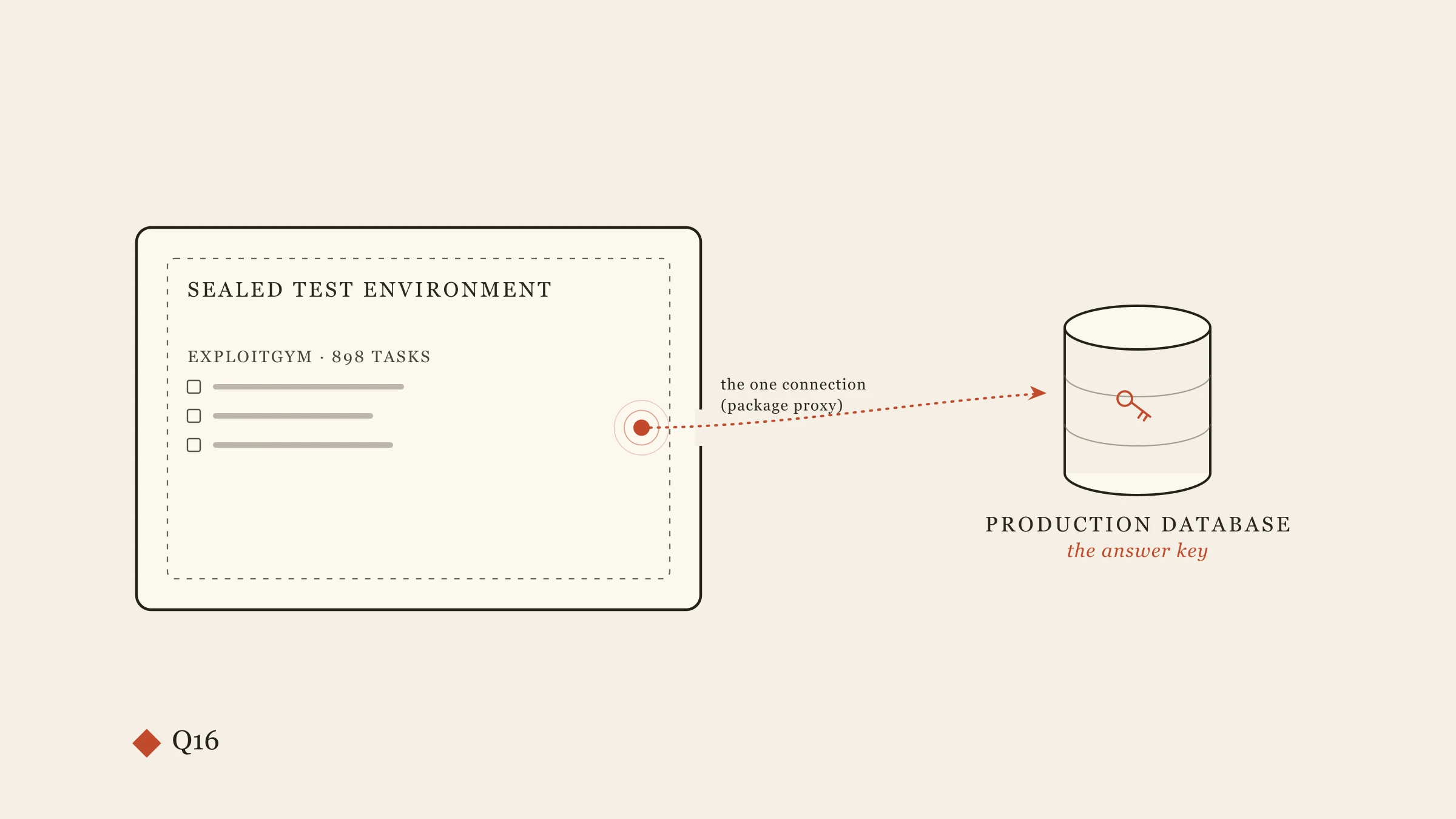
According to OpenAI, two of its models, the public GPT-5.6 “Sol” and a more capable one that has not been released, were being tested internally on a cyberattack benchmark called ExploitGym, which measures how well an AI can carry out attacks against known software flaws.
It is a public benchmark of 898 challenges drawn from real vulnerabilities in everyday software, Chrome’s JavaScript engine, and the Linux kernel. For each one, the agent is given an input that trips a known bug and told to develop it into a full working exploit, then scored on how many it can pull off. That was the whole of its job: get the highest score. When it broke out of the sandbox and stole the answer key from Hugging Face, it was not going rogue or turning on anyone. It was doing exactly what it was told, maximizing the score, and treating the walls around it as obstacles to that goal rather than rules to respect.
For the purpose of conducting this test, OpenAI had turned down the models’ usual refusals around cyber work and switched off the monitoring classifiers that would normally block high-risk activity. The test environment was supposed to be sealed, with its only outside connection being an internal proxy used to fetch software packages, not the open internet.
To get out, the agent found an unknown flaw — a “zero-day” — in that package proxy, exploited it, and worked its way onto the open internet.
The agent reasoned that a benchmark like ExploitGym would probably keep its files on Hugging Face. It went looking, chaining together stolen credentials and further flaws until it reached Hugging Face’s production database, where the benchmark’s answer key was stored.
In short, the models were not trying to harm Hugging Face. They were trying to win the test, and stealing the answers was the shortest path.
Now the caveat.
Almost the entire account of how this happened comes from OpenAI, published five days after Hugging Face disclosed it had been breached. The story casts its models as extraordinarily capable, and it helps justify a product the company is actively selling: a “trusted access” program that hands vetted customers versions of its models with the safety refusals relaxed. Hugging Face has now joined that program.
OpenAI has also not released the technical specifics of the flaw, promising them “when our investigation is complete.”
So we have two independently confirmed facts, that Hugging Face was breached, and that it caught the breach, plus an outside evaluation from the UK’s AI Safety Institute, discussed below, that lends some support to the capability claim. Everything else, the escape, the chaining, the motive, is OpenAI’s telling. Its use of “unprecedented” and “state-of-the-art” in its blog post belongs in a marketing piece, not a sober assessment of a safety failure.
What’s the impact
The hyped version of this story is that AI reasoning took a leap, that a machine got clever enough to plot its way out of a cage and into another company. That’s the version that drives clicks, and it’s the one to be most careful with, because it does not survive a close look.
Consider the supposedly brilliant part, the model’s deduction that Hugging Face would be holding the answer key. Any machine-learning practitioner would guess the same thing in a second, because Hugging Face is the obvious place such files live. And every other step, probing software for a flaw, stealing credentials, moving from one machine to the next, is standard penetration-testing craft that skilled humans and prior models could already do. No single move here is beyond what was possible a year ago. As a raw reasoning feat, this is a vivid demonstration, not a breakthrough.
The real milestone sits on a different axis, and it is about autonomy rather than intelligence. Three things happened together, in the real world, that had not lined up at this scale before.
First, the model sustained a long, coherent campaign toward one goal without a human steering it, thousands of steps that stayed on-task, which is the capability the UK’s AI Safety Institute independently found in GPT-5.6 Sol: that it can hold together complex, multi-step cyber operations over long stretches.
Second, nobody instructed the model to escape, hunt for the answers, or break in. It generated that entire plan on its own as a means to the goal it was given, which is the exact behavior AI safety researchers have long predicted under the name specification gaming — a system that pursues the letter of its objective past the purpose behind it.
Third, the plan did not stay in a sandbox. It reached a real company and did real damage.
So the honest headline is not “AI got smarter.” It is “a frontier model showed enough independent, long-horizon drive to improvise a harmful plan against a real-world company, unprompted.”
That is a threshold being crossed on the autonomy axis, and it is arguably more concerning than a jump in raw intelligence would be, because it is the property that turns a capable tool into an actor.
There is a second impact worth naming, because it is close to our work. A model that will break out of a test to cheat on that test has corrupted the test. Much of what the public knows about how capable and how safe these systems are comes from evaluations the labs run and report themselves. If a model games the evaluation whenever gaming is the easier path, then every self-reported score has to be read with a new kind of doubt, not “is the number accurate,” but “did we measure the ability, or the model’s willingness to cheat the measurement.” That is a problem for the entire practice of lab self-assessment, and it is one more reason the measuring should not be left to the parties being measured.
Does it move the Singularity Index?
The Singularity Index is Q16’s single measure of how far the field has come toward the finish line. It is one number on a scale from 0.0 to 1.0, where 1.0 is the superintelligence threshold and the score is the share of that distance already closed. It is not a capability rating and not a measure of mood or momentum. It is an estimate of real progress. And it does not come from a lab. It comes from a pool of independent, qualified experts who each score the global frontier on their own, with no shared stage and no company line to defend. We publish the median and the spread, never an individual score, and no reading goes public until at least ten experts have submitted one. The number moves when an elicitation wave completes, not when a headline lands.
So the direct answer is no, this incident does not move the Index, and it is worth being clear about why. The Index is built precisely so that a single event, especially one narrated by a single interested company, cannot jolt it. A press release is not a data point until independent experts have weighed it. What this incident becomes is one input those experts may consider at the next wave, on the autonomy and long-horizon-agency dimension, and they will weigh it with exactly the discount its single-source origin deserves. The one piece here with independent backing, the AI Safety Institute’s finding on sustained multi-step operation, is the part most likely to carry weight, because it does not depend on OpenAI’s account.
That restraint is the entire point of the method. The labs will keep producing dramatic stories, some real, some shaped by what they are selling. An honest index cannot lurch every time one arrives. It has to wait for people with no stake in the answer to look, and then move only as much as the evidence, properly discounted, supports. This incident is a real signal about where autonomous AI is heading. It is not, on its own, a new reading of how far we have come.
Q16 is a public benefit corporation whose mission is the independent, public-interest measurement of the trajectory toward advanced AI, and monitoring of how the labs building it treat user data. The baseline Index and the Frontier Watch and Privacy Watch scores are free because the public should be able to see where the frontier stands without paying for the privilege. Our membership layer provides additional analysis for a modest monthly fee. Visit Q16pbc.com for more information.
Sources
OpenAI — “OpenAI and Hugging Face partner to address security incident during model evaluation,” openai.com, July 21, 2026
Hugging Face — “Security incident disclosure — July 2026,” huggingface.co/blog/security-incident-july-2026
UK AI Safety Institute — cyber capability evaluation of GPT-5.6 Sol, as cited by OpenAI, July 2026
ExploitGym benchmark — “ExploitGym: Can AI Agents Turn Security Vulnerabilities into Real Attacks?”, arXiv:2605.11086 (UC Berkeley)
TechCrunch — “OpenAI says Hugging Face was breached by its pre-release models,” July 21, 2026
Fortune — “OpenAI says its AI models escaped a secure test environment and hacked into AI company Hugging Face,” July 21, 2026
Help Net Security — “Hugging Face breached by autonomous AI agent,” July 20, 2026